

7 Mistakes Why Neem Oil isn’t Working on Your Plants
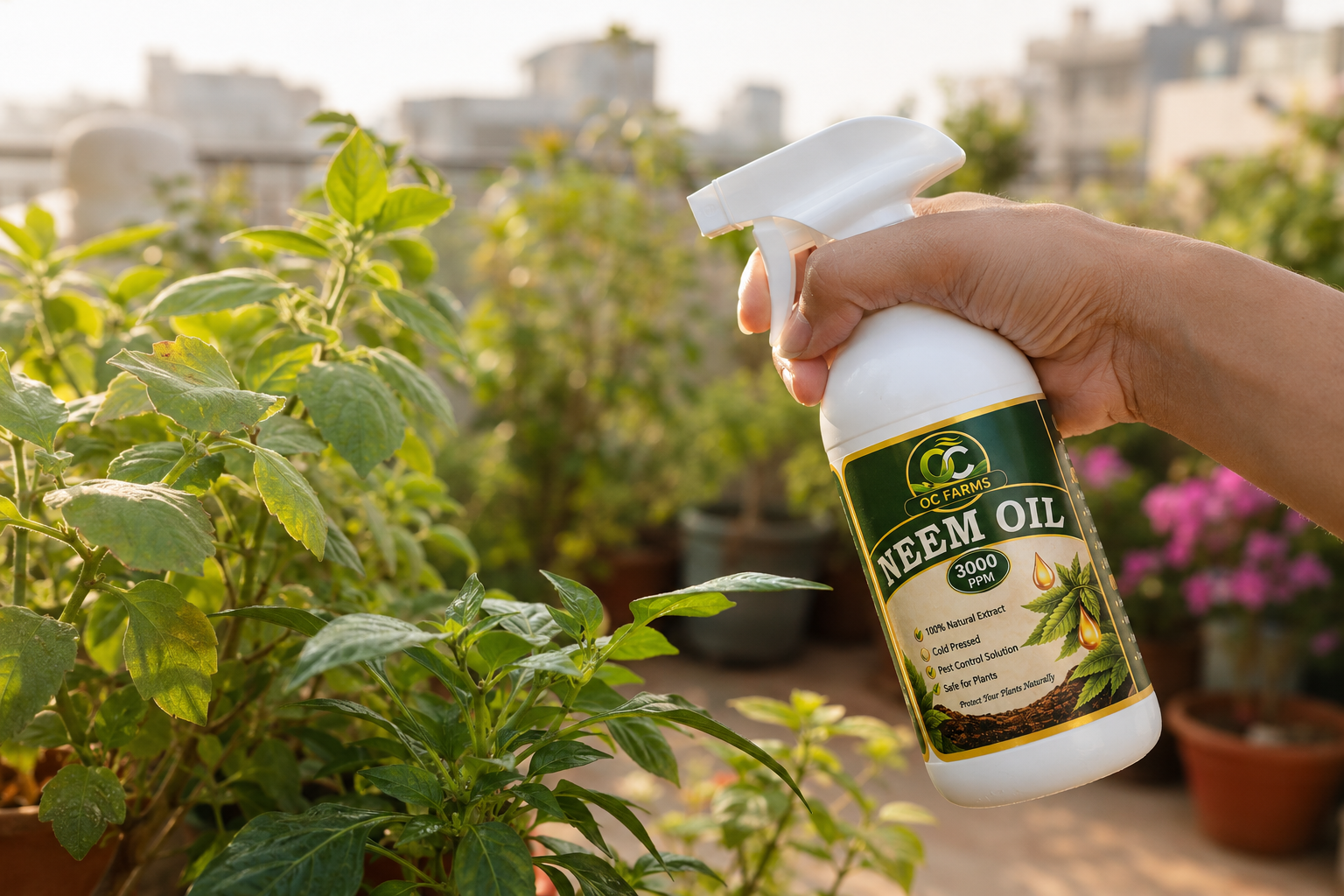
Neem oil is supposed to be the magic solution. You read about it in every gardening group. You bought a bottle. You sprayed your plants. And then… nothing. The pests are still there. Or worse — your leaves started turning brown and your plant looks worse than before.
You are not alone. This is one of the most common frustrations among Indian home gardeners, and the reason is almost never the neem oil itself. It is almost always how it was used.
The problem is that most neem oil guides online are written for Western climates — mild summers, soft municipal water, and temperatures that rarely cross 30°C. In India, we are dealing with 42°C terraces in May, hard tap water with high TDS, and humidity swings from desert-dry to monsoon-wet. The rules are different here.
Here are the 7 Mistakes Why Neem Oil isn’t Working on Your Plants — and exactly how to fix each one.
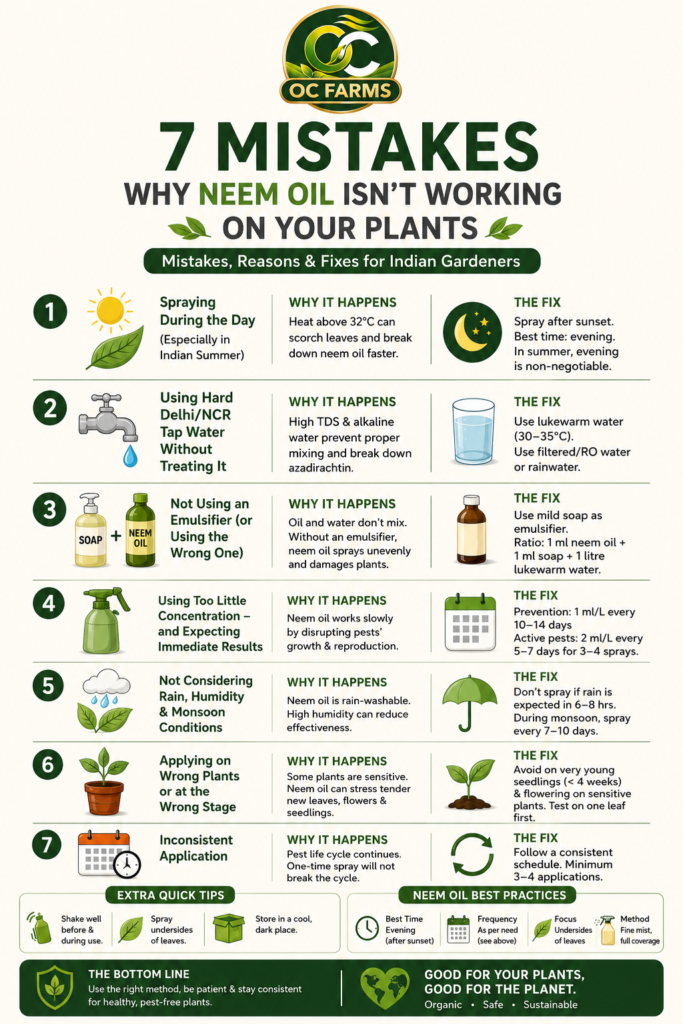
Mistake #1: Spraying During the Day (Especially in Indian Summer)
This is the single most common mistake, and it is devastating during Indian summers.
Neem oil is a fatty oil. When you spray it on leaves and the sun hits, the oil heats up rapidly — essentially frying the leaf surface from the outside. You will see brown scorch marks, burned patches, and crispy leaf edges within hours of a daytime spray during peak summer. According to horticulture experts, applying neem oil above 32°C (90°F) significantly increases the risk of leaf burn and also causes the oil’s active compounds to break down faster.
In Delhi, Mumbai, or any city where April–June temperatures routinely cross 40°C, spraying neem oil at 10 AM is like putting your plant under a magnifying glass.
The fix: Always spray neem oil after sunset. Evening is ideal. This gives the oil 8–10 hours to dry and absorb before the sun comes back. If you must spray in the morning, do it before 6:30 AM — and only between October and February when temperatures are manageable. In summer, evening is non-negotiable.
Mistake #2: Using Hard Delhi/NCR Tap Water Without Treating It
This is the silent killer that almost no blog ever talks about — and it is especially relevant if you live in Delhi, Noida, Gurgaon, Faridabad, or anywhere in the NCR belt.
Delhi tap water has relatively high TDS (Total Dissolved Solids), typically ranging from 400–800 ppm — well above the WHO ideal of 300 ppm — with a tendency toward hardness due to calcium and magnesium minerals. When you mix neem oil with hard water, the oil does not emulsify as cleanly — it can separate into blobs and patches instead of forming a fine, even mist. Additionally, alkaline hard water is less hospitable to the oil’s active compound azadirachtin, which degrades faster in high-pH environments.
You shake the bottle, but you can still see oily globules floating on the surface. That is your neem oil failing to mix.
The fix: Use lukewarm water — not cold, not hot, but warm (around 30–35°C). This dramatically improves emulsification. If your tap water is very hard, use filtered or RO water, or add a few drops of apple cider vinegar to slightly lower the pH. Collected rainwater is also ideal — naturally soft and slightly acidic.
Mistake #3: Not Using an Emulsifier (or Using the Wrong One)
Neem oil and water do not mix. Oil and water never do without help. You need an emulsifier — a soap or surfactant that allows the oil to break into tiny droplets and stay suspended in water. As the University of New Hampshire Extension explains, neem oil must coat the plant completely to work, and that is only possible with proper emulsification.
Many Indian gardeners either skip this step entirely (so the neem oil just floats on top and sprays unevenly) or use whatever soap is nearby — often detergents, phenyl-based liquids, or harsh floor cleaners. These can damage plants and disrupt the oil’s chemistry.
The fix: Use a mild, gentle soap as your emulsifier. A few options that work well in India:
- Plain liquid hand wash (fragrance-free, without antibacterial additives) — about 1 ml per litre of water
- Neem-based dishwash liquid — adds to pest control while helping emulsification
- Castile soap if you can find it
The ratio that works: 1 ml neem oil + 1 ml mild soap + 1 litre lukewarm water. Mix the soap into the water first, then slowly add the neem oil while stirring vigorously. Shake your sprayer before every few sprays during application — neem oil solutions separate quickly.
Mistake #4: Using Too Little Concentration — and Expecting Immediate Results
Neem oil is not a contact killer that wipes out pests on first contact like a chemical pesticide. It works differently. The active compound azadirachtin disrupts the hormonal and reproductive system of insects — it interferes with their ability to grow, shed their skin, and lay eggs. This process takes time, typically 4–7 days to see any visible reduction.
Most Indian gardeners spray once, see the pests still moving around the next morning, and conclude neem oil does not work. They give up too soon.
Additionally, many use too dilute a concentration. A 0.5% solution is fine for prevention. For active infestations, you need a 1–2% solution sprayed consistently every 5–7 days for 3–4 applications.
The fix:
- For prevention: 1 ml neem oil per litre of water, spray once in 10–14 days
- For active pest attack: 2 ml neem oil per litre of water, spray every 5–7 days for at least 3–4 applications
- Be patient — visible reduction usually starts appearing after the 2nd or 3rd application
- Always spray the undersides of leaves thoroughly. Most pests live and lay eggs there, not on top.
Mistake #5: Spraying Right Before or After Rain (Very Common During Monsoon)
This mistake spikes every June–September in India. You spray your plants in the morning, it rains by afternoon, and all your neem oil washes away before it has had any chance to work.
Neem oil needs sufficient time on the leaf surface to be absorbed and effective. Rain — even a light shower — washes off most of it before absorption is complete. It is best practice to avoid spraying if rain is expected within 24 hours.
The reverse is also a problem. Spraying right after rain on wet leaves causes the neem oil to pool and drip rather than form an even coating, leading to uneven coverage and even minor burning in spots where the oil concentrates.
The fix: Check the weather before you spray. Do not spray if rain is expected within 24 hours. During monsoon, target that window between rains — often there are 2–3 clear days between heavy spells. Spray in the evening of a clear day and let it sit overnight and through the following dry day. Also, always let the plant’s leaves be dry before spraying — shake off any water droplets first.
Mistake #6: Using Expired or Degraded Neem Oil
Neem oil has a shelf life, and in India’s heat and humidity, it degrades faster than most packaging suggests.
Pure cold-pressed neem oil begins to solidify when temperatures drop — different sources note this starts happening anywhere between 18°C and 25°C depending on the batch’s fatty acid composition. So in Indian winters, a semi-solid neem oil is actually a sign of purity, not damage. More importantly, once you mix neem oil with water and soap, the solution remains at peak effectiveness for only 4–8 hours — though it may retain some residual activity for up to 24 hours. Mixing a large batch on Saturday and spraying the leftovers on Wednesday will give you very little pest control benefit.
The fix:
- Buy cold-pressed neem oil from a trusted source that mentions azadirachtin content (higher is better — 3000 ppm is among the most potent concentrations available)
- Store unmixed neem oil in a cool, dark place — away from direct sunlight and heat
- Use the solution within 8 hours of mixing; make small, fresh batches each time you spray
- Good quality neem oil has a strong, distinct smell (often described as garlic-like or sulfurous) — if yours is nearly odourless, the azadirachtin content has likely degraded
Mistake #7: Spraying the Same Pest With Neem Oil Alone — Without Covering All Surfaces
Neem oil works as both a contact treatment and a systemic disruptor. It needs to physically touch the pest or the surface where eggs are laid to be effective. If you are only spraying the top of your leaves and missing the undersides, stems, and soil surface, you are treating maybe 30% of the problem while 70% of the pest population continues reproducing undisturbed.
This is especially true for mealybugs, spider mites, and whiteflies — all of which cluster on the undersides of leaves and in stem joints, not on the visible top surface of leaves.
Also, for severe infestations, neem oil alone may not be sufficient. The pest population can reproduce faster than neem oil’s slow-acting mechanism can suppress it.
The fix:
- When spraying, turn your sprayer nozzle upward and coat the undersides of every leaf, not just the tops
- Spray the stem joints, the soil surface, and the rim of the pot as well
- For heavy infestations, combine approaches: manually remove visible mealybugs or spider mite clusters with a cotton swab dipped in neem oil first, then follow up with a full spray treatment
- Consider pairing neem oil with a high-concentration cold-pressed neem oil product (3000 ppm) for faster knock-down of severe infestations
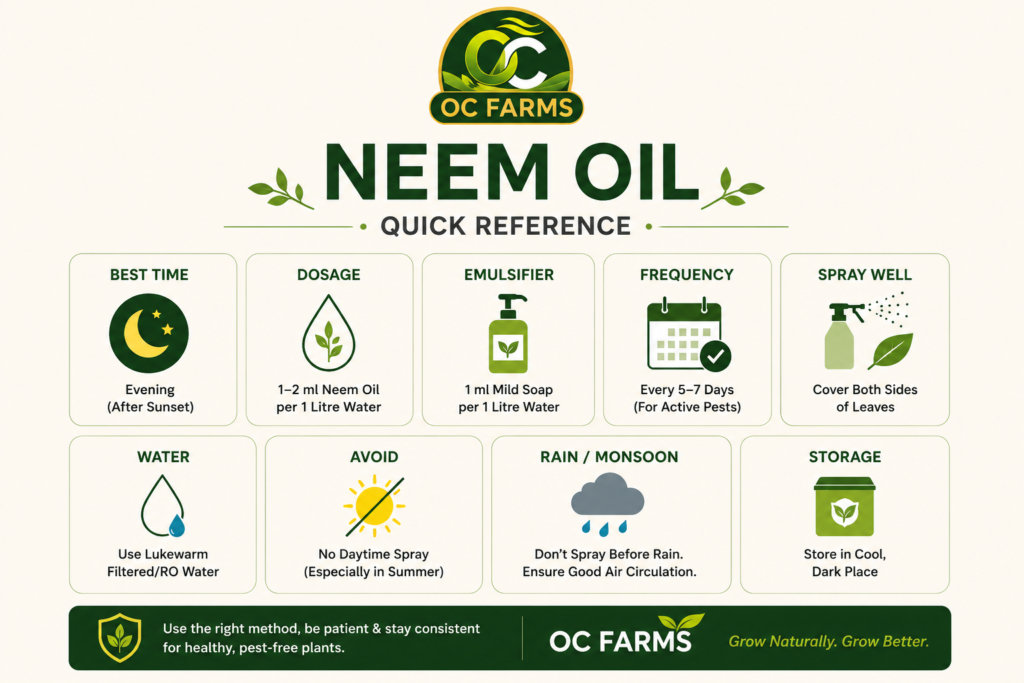
Quick Reference: The Right Way to Use Neem Oil in India
| What | How |
|---|---|
| Concentration (prevention) | 1 ml neem oil per litre of water |
| Concentration (active pest) | 2 ml neem oil per litre of water |
| Emulsifier | 1 ml mild liquid soap per litre |
| Water temperature | Lukewarm (30–35°C) |
| Best time to spray | After sunset |
| Frequency (prevention) | Once every 10–14 days |
| Frequency (active pest) | Every 5–7 days for 3–4 applications |
| Shelf life of mixed solution | Use within 8 hours for best results |
| Avoid spraying | In direct sun, before/after rain, on stressed or newly transplanted plants |
| Coverage | Top and underside of leaves, stems, soil surface |
What Type of Neem Oil Works Best?
Not all neem oil is equal. Here is a simple breakdown:
Cold-pressed neem oil retains the highest levels of azadirachtin — the active compound responsible for pest control. Look for products that clearly state azadirachtin content. For serious infestations, higher concentration delivers stronger results.
Clarified hydrophobic neem oil (often sold as “water-soluble neem”) is processed to remove most of the azadirachtin. It works primarily as a contact insecticide by coating and suffocating soft-bodied pests, but it also retains some fungicidal properties against mildews and rusts. According to the U.S. EPA, clarified hydrophobic neem oil does not contain azadirachtin and therefore does not have the hormonal growth-disruption effect on insects that cold-pressed neem oil has.
For home gardeners in India dealing with mealybugs, aphids, spider mites, or whiteflies, a high-concentration cold-pressed neem oil used consistently and correctly will outperform any chemical spray in the long run — without damaging your soil health or risking chemical residue on your vegetables.
How to Make Neem Oil Spray for Plants — The Right Way
The correct neem oil spray for plants requires three things: the right oil, the right emulsifier, and the right water temperature.
Start with 1 litre of lukewarm water (30–35°C). Add 1 ml of mild liquid soap and mix first. Then slowly add 1–2 ml of cold-pressed neem oil while stirring continuously. Pour into a sprayer and shake well before every few sprays during application.
For indoor plants and houseplants, use the lower end — 1 ml neem oil per litre. For outdoor plants with active pest infestations, go up to 2 ml per litre. Always spray in the evening, coat both sides of leaves, and use the entire batch within 8 hours.
FAQ
How long does it take for neem oil to kill pests?
Neem oil typically takes 4–7 days to show visible results. It is not an instant knockdown pesticide — it works by disrupting the insect’s ability to feed and reproduce over time. Consistency across 3–4 spray cycles is key.
Can I spray neem oil every day?
No. Over-spraying builds up an oily residue on leaves that blocks the stomata (breathing pores), which can suffocate the plant. For active infestations, every 5–7 days is the right frequency.
Is neem oil safe for vegetables and edible plants?
Yes. According to the National Pesticide Information Center (NPIC), neem oil is practically non-toxic to birds, mammals, and bees when used correctly. It is widely used in organic vegetable growing worldwide.
Why does my neem oil smell so strong?
That strong garlic-sulfur smell is a good sign — it indicates the oil is fresh and has a healthy azadirachtin content. Neem oil that has little to no smell has likely degraded and will not be effective.
What is the correct neem oil to water ratio for plants?
For prevention, use 1 ml of cold-pressed neem oil per litre of lukewarm water with 1 ml of mild soap as emulsifier. For active infestations, increase to 2 ml neem oil per litre. Always mix soap into water first, then add neem oil slowly while stirring. Use within 8 hours of mixing.
Is neem oil safe for houseplants and indoor plants?
Yes, neem oil is safe for houseplants and indoor plants when used at the correct dilution — 1 ml per litre with a mild soap emulsifier. For indoor use, spray in the evening or move the plant outdoors briefly after spraying to avoid the strong smell indoors. Wipe down leaves after 12 hours if the smell is an issue.
Which pests does neem oil spray work on?
Neem oil spray is effective against aphids, mealybugs, spider mites, whiteflies, and fungus gnats. It works best when applied consistently every 5–7 days for 3–4 cycles. For severe mealybug infestations, combine neem oil spray with manual removal using a cotton swab first.
Final Word
Neem oil works. It has been used in Indian agriculture and medicine for centuries for good reason. But it demands the right conditions, the right timing, and a bit of patience — especially when you are gardening on a Delhi terrace in 40°C heat with mineral-heavy tap water.
Fix these seven mistakes, and you will see a completely different result.
OC Farms offers cold-pressed neem oil , sourced for Indian gardening conditions. Free shipping above ₹499.
One Response