

How to Fertilize Indoor Plants — The Complete Beginner’s Guide for India
Most indoor plant problems come down to two things — water and light. But once those are dialled in, the next question every plant owner asks is whether their plants need feeding. The answer is almost always yes — but how you fertilize matters far more than whether you fertilize.
Get it right and your plants grow faster, look healthier, and resist disease better. Get it wrong and you burn the roots, lock out nutrients, or waste money on fertilizer your plant cannot even use.
This guide covers everything — what fertilizer actually is, which type to choose, when to apply it, how much to use, and the mistakes that damage plants silently for weeks before you notice. It also covers two of the best natural fertilizer options available in India — seaweed liquid fertilizer and vermicompost — and why serious plant owners are switching to them.
Give your plants the nutrition they need — explore our Shop Now collection of plant fertilizers and care products.
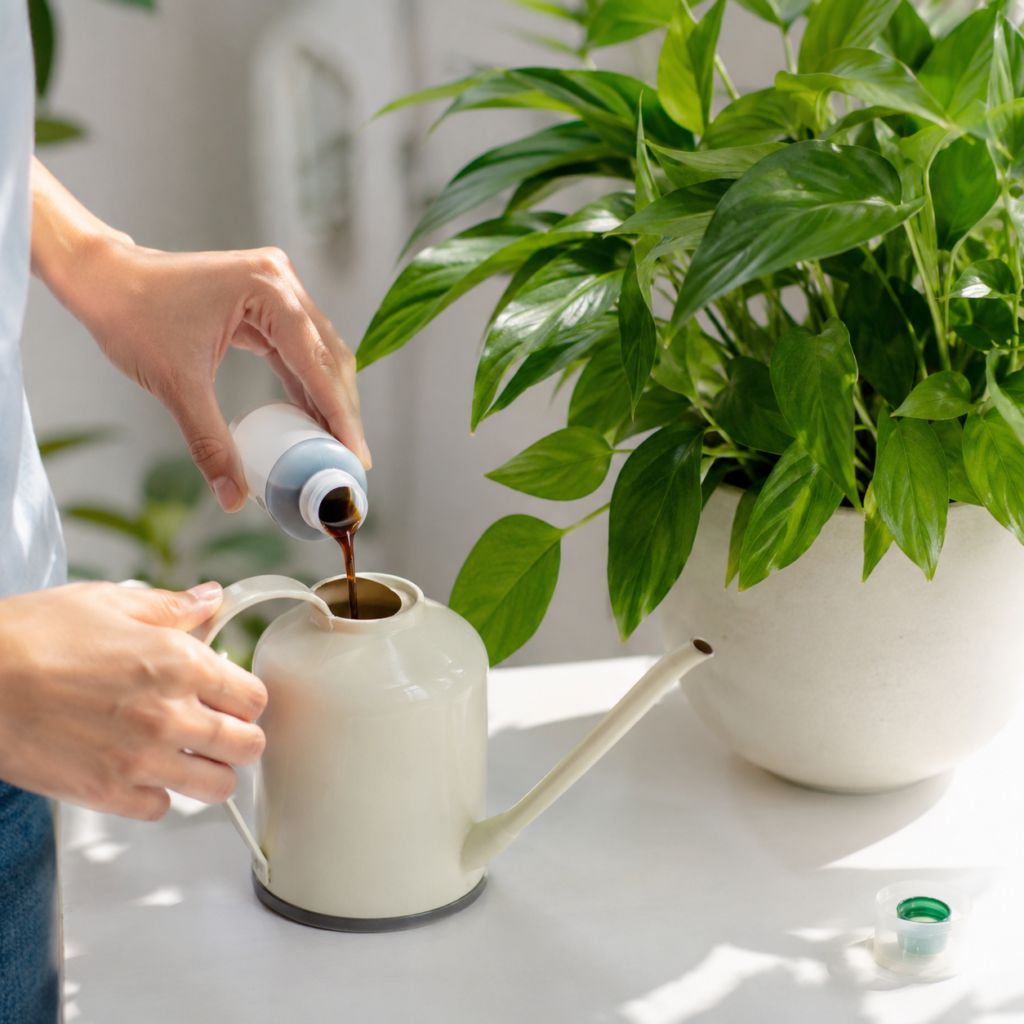
What Is Fertilizer and Why Do Indoor Plants Need It
In nature, plants grow in soil that is constantly replenished. Fallen leaves decompose, organic matter breaks down, rain carries minerals through the ground. The soil feeds itself continuously.
In a pot, that cycle does not exist. A plant sits in the same finite volume of soil indefinitely. Every time you water, small amounts of nutrients leach out through the drainage holes. Over months, the soil becomes progressively depleted. Without replacement nutrients the plant runs out of the raw materials it needs to grow, produce chlorophyll, and defend itself against pests and disease.
Fertilizer replaces those depleted nutrients. It is not a magic growth booster — it is basic nutritional maintenance. A plant that is not fertilized during its growing season is like a person eating plain rice every single day. It survives but never thrives.
If your plant leaves are turning yellow despite correct watering and light, nutrient depletion could be the underlying cause — read our full guide on why plant leaves turn yellow for a complete diagnosis checklist.
Understanding NPK — The Three Numbers on Every Fertilizer
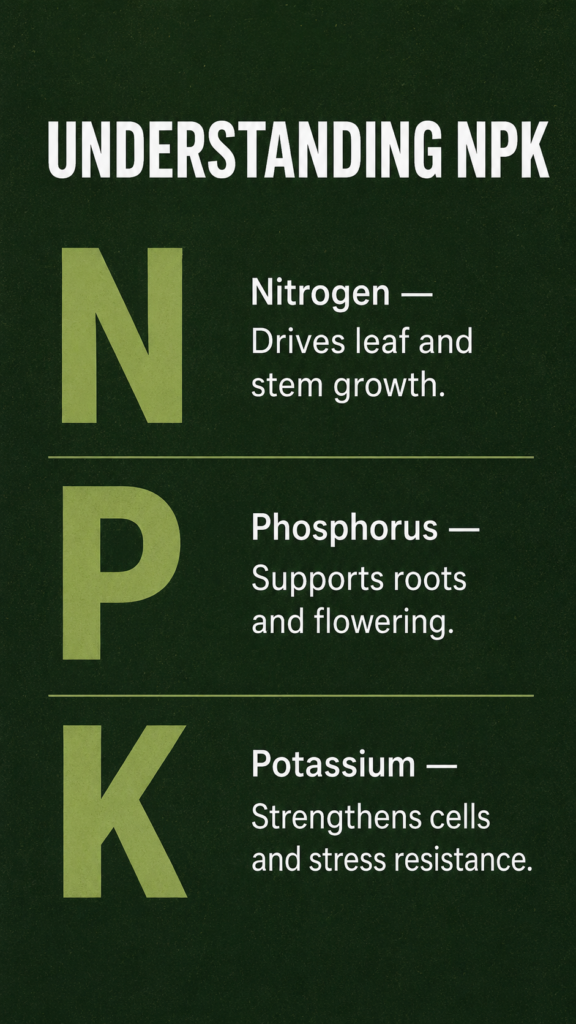
Every fertilizer package shows three numbers separated by dashes — something like 10-10-10 or 5-3-8. These numbers represent the percentage by weight of the three primary macronutrients: Nitrogen, Phosphorus, and Potassium. This ratio is called NPK.
Nitrogen — the N Nitrogen drives vegetative growth. It is the primary building block of chlorophyll and amino acids. Plants with adequate nitrogen produce lush deep green leaves and grow vigorously. Deficiency shows up as uniform yellowing starting from the oldest lower leaves — the plant pulls nitrogen from old growth to feed new growth.
Foliage plants like pothos, monstera, philodendrons, and ferns need relatively high nitrogen since leaf production is their primary function.
Phosphorus — the P Phosphorus supports root development, flower production, and energy transfer within the plant. It is especially important for young plants establishing root systems and for flowering houseplants during bloom cycles — peace lilies, anthuriums, and African violets all benefit from higher phosphorus when budding.
Potassium — the K Potassium regulates water movement in and out of plant cells, strengthens cell walls, and improves stress resistance. It does not drive visible growth directly but works as an essential support system for overall plant health. Deficiency shows up as yellowing and browning along the edges and tips of older leaves.
How Often Should You Fertilize Indoor Plants?
This is where most people go wrong — either feeding too frequently and burning roots or feeding so rarely the plant runs on empty all season.
The honest answer is that frequency depends on three things: the type of fertilizer you use, the season, and your specific plant. Here is a clear breakdown.
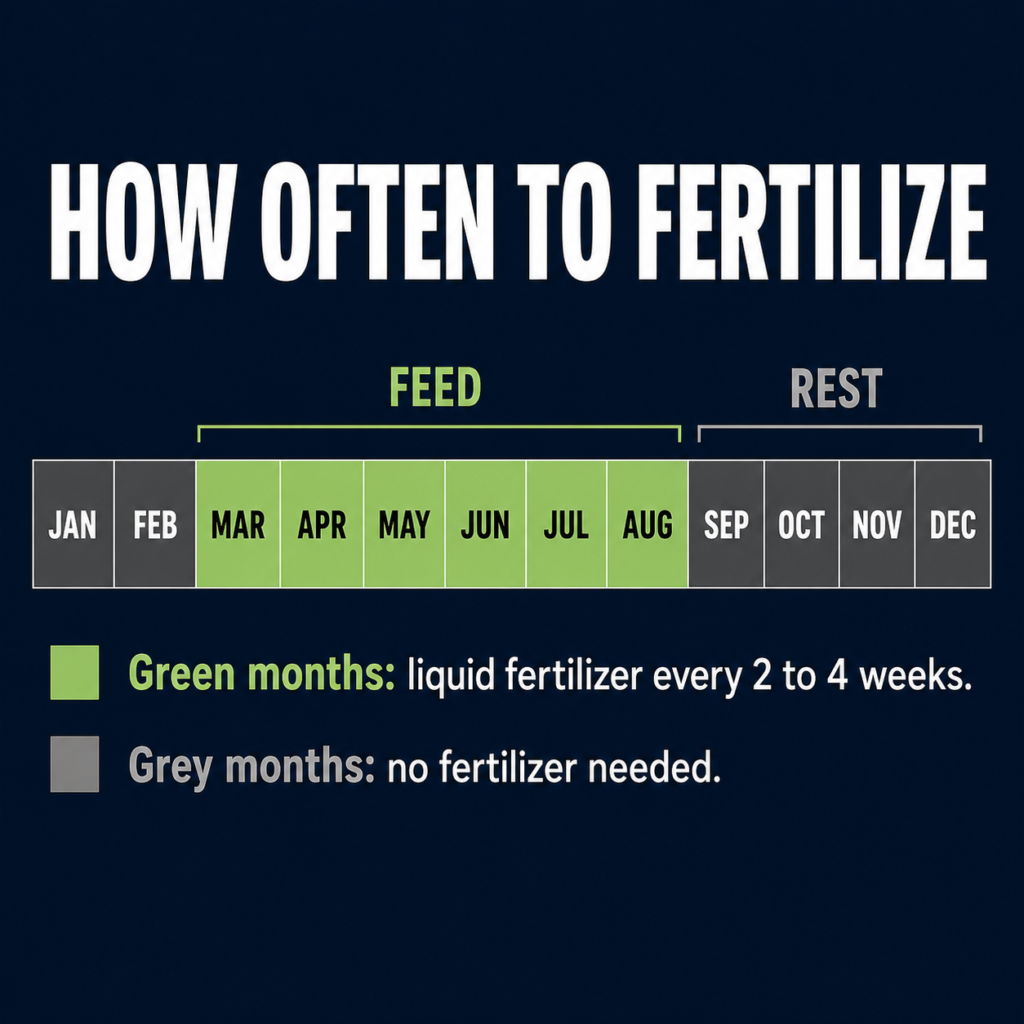
Liquid fertilizer — every two to four weeks during growing season Liquid fertilizer is absorbed quickly and leaches out of the soil within two to four weeks. This means it needs consistent reapplication throughout spring and summer to maintain steady nutrition. Every two weeks for fast growing plants like pothos and monstera. Every three to four weeks for slower growers like snake plants and ZZ plants.
Slow release granules — once every three to six months Granules release nutrients slowly as water passes through them. One application at the start of spring typically covers the entire growing season. Do not top up mid season unless the plant shows clear signs of deficiency — granules accumulate and overapplication causes salt buildup.
Organic options like seaweed and vermicompost — every three to four weeks Natural fertilizers release nutrients gently and are far harder to overapply. They can be used slightly more frequently than chemical fertilizers without risk of burning. Every three weeks during active growth is a solid routine for most indoor plants.
The universal rule regardless of fertilizer type Never fertilize in autumn and winter. As daylight shortens, most indoor plants slow down or enter semi-dormancy. Their metabolic activity drops and they cannot process fertilizer. Nutrients sit unused, mineral salts accumulate, and root damage follows. Stop feeding in September and resume in March.
Never fertilize a sick, stressed, or recently repotted plant. A compromised root system cannot process nutrients — fertilizer only adds stress. Stabilise the plant first and wait for new healthy growth before resuming feeding.
How to Use Liquid Fertilizer on Houseplants
Liquid fertilizer is the most practical and beginner-friendly option for indoor plants. It distributes nutrients evenly, works quickly, and gives you precise control over dose. Here is exactly how to use it correctly.
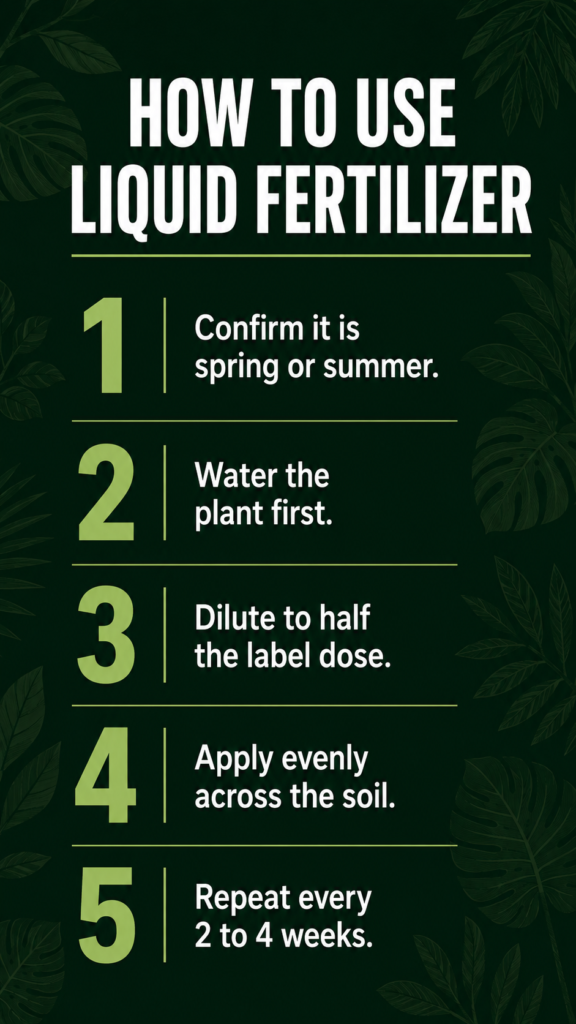
Step 1 — Confirm it is the right season Spring and summer only — March through August. If it is winter, put the fertilizer away.
Step 2 — Water the plant first Never apply fertilizer to dry soil. Dry roots absorb more aggressively and are more vulnerable to salt damage. Water the plant normally, allow it to drain completely, then apply fertilizer to moist soil. This protects the roots and helps distribute the fertilizer evenly through the soil.
Step 3 — Dilute to half the recommended dose This is the most important step. The doses printed on fertilizer labels are calibrated for garden beds and outdoor plants with large soil volumes. A potted houseplant in a limited volume of soil has no buffer for excess nutrients. Use half the dose stated on the label — every single time. For most liquid fertilizers this means half a capful per litre of water instead of a full capful.
Step 4 — Apply evenly across the entire soil surface Do not concentrate the fertilizer in one spot. Pour it slowly and evenly across the whole surface so it distributes uniformly through the root zone. Allow it to drain through the pot normally.
Step 5 — Note the date and repeat in two to four weeks Keep a simple note on your phone of when you fertilized. This prevents accidental double dosing. Repeat every two to four weeks throughout the growing season.
Signs liquid fertilizer is working: New leaves emerging regularly. Existing leaves deepening in color. Stems growing visibly stronger. Noticeable improvement within four to six weeks of starting a routine.
Signs you are overfeeding with liquid fertilizer: Brown crispy tips and edges on leaves. White crusty deposits on the soil surface or outside of terracotta pots — this is mineral salt buildup. Wilting that does not respond to watering. If this happens, flush the soil with plain water three to four times consecutively and withhold fertilizer for six weeks.
Can You Use Seaweed Fertilizer on Indoor Plants?
Yes — and for most indoor plant owners, seaweed liquid fertilizer is one of the best options available. Here is why it works so well and why it is worth considering over standard chemical fertilizers.
What is seaweed fertilizer? Seaweed fertilizer is derived from marine algae — most commonly kelp or brown seaweed. It is processed into a liquid concentrate that is diluted with water before application. Unlike synthetic NPK fertilizers, seaweed fertilizer is not primarily a macronutrient source. Its value lies in something different and more complex.
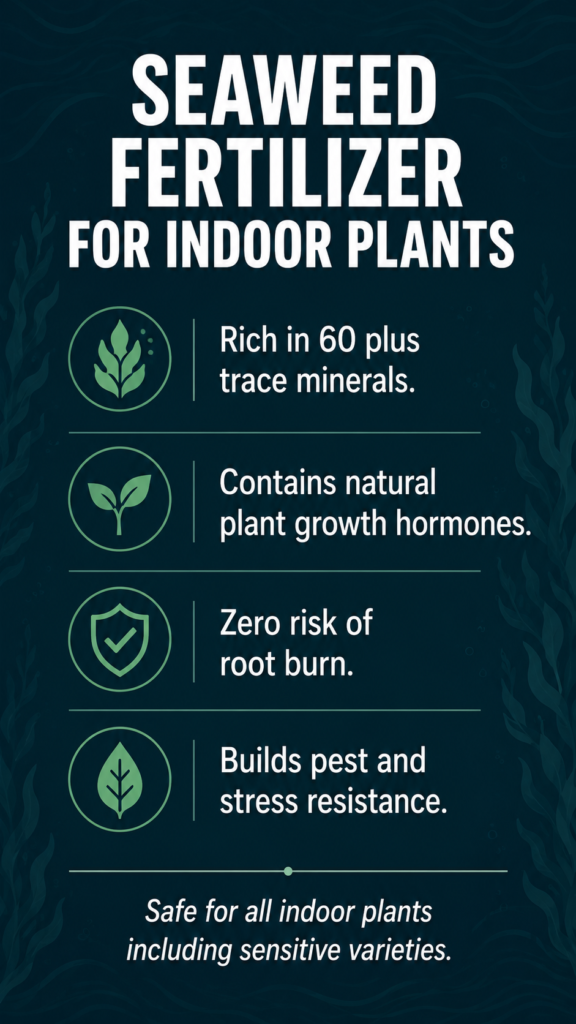
What seaweed fertilizer actually does Seaweed extract is rich in natural plant hormones — particularly cytokinins and auxins — which directly stimulate cell division and root development. It contains over 60 trace minerals and micronutrients including iron, manganese, zinc, and boron that most synthetic fertilizers do not include. It also contains alginic acid which improves soil structure and water retention, and natural compounds that stimulate the plant’s own immune responses making it more resistant to stress, pests, and disease.
The result is plants that do not just grow faster — they grow stronger. Thicker stems, deeper root systems, more vibrant leaf color, and noticeably better resilience to temperature changes and drought stress.
Is seaweed fertilizer safe for all indoor plants? Yes. Seaweed fertilizer is gentle, pH neutral, and carries essentially zero risk of root burn even if you slightly exceed the recommended dose. This makes it ideal for sensitive plants like ferns, calatheas, and orchids that are easily damaged by chemical fertilizers. It is also completely safe for households with children and pets.
How to use seaweed fertilizer on indoor plants Dilute according to product instructions — typically five to ten millilitres per litre of water. Apply to moist soil every three to four weeks during the growing season. It can also be applied as a foliar spray directly on leaves at a more diluted concentration — this delivers micronutrients directly through the leaf surface and is particularly effective for plants showing signs of micronutrient deficiency like interveinal chlorosis.
Seaweed fertilizer vs chemical fertilizer for indoor plants Chemical fertilizers deliver high doses of NPK quickly but carry a real risk of root burn with even slight overdosing, contribute to salt buildup over time, and do nothing to improve soil biology or plant immunity. Seaweed fertilizer feeds more gently, improves the overall growing environment, and builds plant resilience over time. For long-term indoor plant health, seaweed is the smarter investment.
Our Seaweed Liquid Fertilizer is cold-processed to preserve active plant hormones and trace minerals — explore it in our Shop Now collection.
How to Fertilize Houseplants with Vermicompost
Vermicompost — also called worm castings — is the richest and most complete natural fertilizer available for indoor plants. It is produced by earthworms processing organic matter and the result is a nutrient-dense, microbe-rich material that feeds plants and transforms soil biology simultaneously.
Why vermicompost is exceptional for indoor plants Unlike synthetic fertilizers that feed the plant directly, vermicompost feeds the soil. It introduces billions of beneficial microorganisms that break down organic matter, make nutrients more bioavailable to roots, suppress harmful soil fungi, and improve soil structure. The result is a living, active soil environment in your pot rather than a sterile growing medium that depends entirely on what you pour into it.
Vermicompost contains a balanced, slow-release supply of nitrogen, phosphorus, and potassium alongside a full spectrum of micronutrients. It also contains humic acids which significantly improve the soil’s ability to retain moisture and nutrients, and plant growth hormones including auxins and cytokinins similar to those found in seaweed extract.
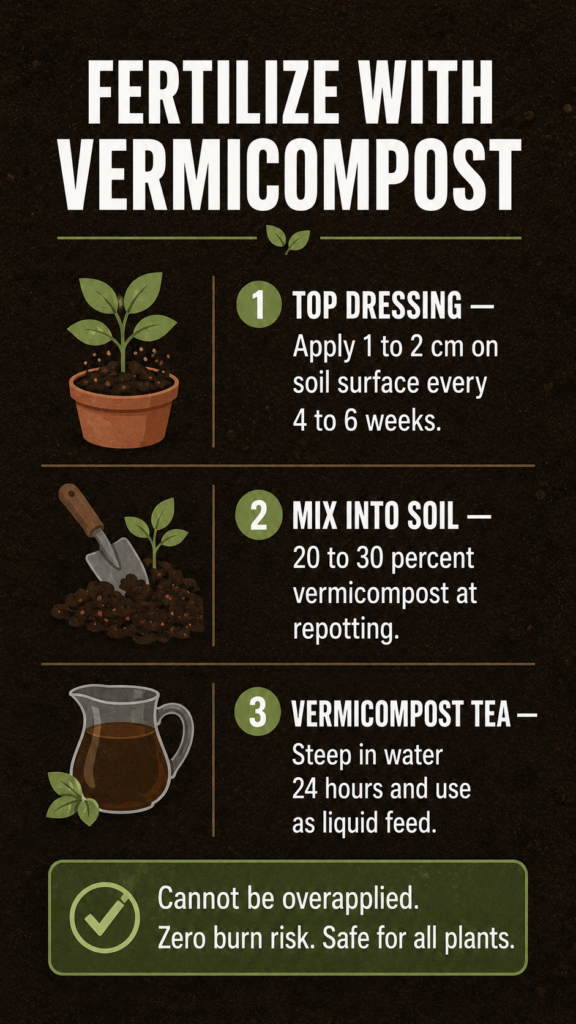
The most important advantage for indoor plant owners It is essentially impossible to overapply vermicompost. There is no salt toxicity risk, no root burn risk, and no danger of nutrient lockout from excess application. This makes it the safest fertilizer option for beginners who are unsure about dosing.
How to use vermicompost on indoor plants
Method 1 — Top dressing. Apply one to two centimetres of vermicompost across the top of the soil surface and water normally. The nutrients leach down through the soil with each watering. Repeat every four to six weeks during the growing season. This is the simplest and most effective method for established potted plants.
Method 2 — Mix into potting soil at repotting. When repotting, mix vermicompost into your potting soil at a ratio of roughly 20 to 30 percent vermicompost to 70 to 80 percent potting mix. This creates a rich, well-structured growing medium that feeds the plant gradually for months.
Method 3 — Vermicompost tea. Steep vermicompost in water for 24 hours, strain, and use the liquid to water your plants. This delivers soluble nutrients and beneficial microorganisms directly to the root zone and works exceptionally well as a liquid feed during active growth.
Which plants respond best to vermicompost All indoor plants benefit but foliage plants — monstera, pothos, fiddle leaf fig, philodendron — show the most dramatic visible response. Flowering houseplants produce more blooms and longer bloom cycles. Even slow-growing succulents benefit from occasional vermicompost top dressing for improved soil health.
Our Vermicompost is sourced from fully processed earthworm castings with no fillers — explore it alongside our full fertilizer range in our Shop Now collection.
Fertilizer for Specific Plant Types
Foliage plants — pothos, monstera, philodendron, snake plant, ferns Higher nitrogen needed. Balanced 10-10-10 liquid or seaweed fertilizer every two to three weeks in growing season. Vermicompost top dressing once a month works excellently alongside liquid feeding.
Flowering houseplants — peace lily, anthurium, African violet Switch to a higher phosphorus formula when flower buds are forming. Return to balanced formula after flowering ends. Seaweed fertilizer applied as a foliar spray supports blooming particularly well.
Succulents and cacti Low fertilizer needs. Feed once a month at most during summer at quarter strength. Vermicompost top dressing once in spring is often sufficient for the entire season. Never overfeed — it produces weak stretched growth.
Newly propagated plants Wait until four to six weeks after moving to soil and showing consistent new growth. Start with seaweed fertilizer at half strength or a light vermicompost top dressing — both are gentle enough for sensitive young root systems.
Quick Reference Cheat Sheet
When to fertilize — spring and summer only, March through August
Liquid fertilizer frequency — every two to four weeks
Seaweed fertilizer frequency — every three to four weeks
Vermicompost frequency — top dressing every four to six weeks
Always do this first — water before applying any fertilizer
Dose for liquid — always half the label recommendation
Safest option for beginners — vermicompost, impossible to overapply
Best for sensitive plants — seaweed liquid fertilizer
Do not fertilize when — winter, recently repotted, sick or stressed plant
Fix for overfertilizing — flush soil with plain water, withhold fertilizer six weeks
Frequently Asked Questions(FAQ)
How often should you fertilize indoor plants in India?
During the Indian growing season — roughly February through October given India’s warmer climate — feed every two to four weeks with liquid fertilizer or every three to four weeks with seaweed fertilizer. India’s longer warm season means indoor plants stay in active growth longer than in colder climates, so the feeding window is extended compared to standard advice written for European or North American conditions. Reduce or stop feeding during the cooler months of November through January.
Can you use seaweed fertilizer on indoor plants every week?
Weekly application is more than most indoor plants need and may lead to minor nutrient buildup over time even with a gentle fertilizer like seaweed. Every three to four weeks is the optimal frequency for seaweed liquid fertilizer on indoor plants. If you want to increase frequency, dilute to quarter strength and apply every two weeks — this keeps nutrient delivery consistent without accumulation.
Is vermicompost better than chemical fertilizer for indoor plants?
For long-term plant health, yes. Chemical fertilizers deliver nutrients faster and in higher concentrations, which produces quick visible results. But they do nothing to improve soil biology, carry a real risk of root burn with overdosing, and contribute to salt buildup over time. Vermicompost feeds more slowly, builds the soil ecosystem, improves moisture retention, and cannot burn roots. For indoor plants in particular — where soil health matters enormously in a closed pot environment — vermicompost produces better long-term results than synthetic fertilizers.
What happens if I never fertilize my indoor plants?
The plant will not die immediately, especially after a recent repot into fresh potting mix. Over time however, nutrients deplete, growth slows significantly, leaves become smaller and paler, and the plant becomes more susceptible to pests and disease. For genuine long-term plant health, fertilizing during the growing season is necessary.
Can I use seaweed fertilizer and vermicompost together?
Yes and this is actually one of the best combinations for indoor plants. Vermicompost as a top dressing provides slow-release macronutrients and improves soil biology. Seaweed liquid fertilizer provides micronutrients, plant hormones, and a quick bioavailable nutrient boost. Together they cover the full spectrum of plant nutritional needs. Apply vermicompost top dressing once a month and seaweed liquid every three weeks alongside it.
Why are my plant leaves still yellow after fertilizing?
Fertilizer takes two to four weeks to show visible results. If yellowing continues beyond four weeks of correct feeding, the cause is likely something other than nutrient deficiency. Check soil moisture — overwatering is far more commonly the cause of yellow leaves than nutrient deficiency. Also confirm you are fertilizing during the active growing season and that soil pH is between 6.0 and 7.0 — nutrients become unavailable outside this range regardless of how much fertilizer is present. Read our full guide on why plant leaves turn yellow for a complete diagnosis.
The Bottom Line
Fertilizing indoor plants is not complicated but it requires respecting two non-negotiable rules — feed only during active growth in spring and summer, and always use less than you think you need.
For Indian plant owners specifically, natural options like seaweed liquid fertilizer and vermicompost are worth taking seriously. They are gentler, safer, improve overall soil health, and build the kind of plant resilience that makes every other aspect of plant care easier over time.
Your plants will show you the difference within four to six weeks of a consistent feeding routine.
“Excellent article! One of the clearest guides I’ve read on indoor plant fertilization. The practical tips on vermicompost, seaweed fertilizer, and proper feeding schedules make it easy for beginners to keep their plants healthy and thriving. Great work!” 👍
Thanks, Nishith! Glad you enjoyed the article. Happy gardening and keep growing! 🌱