

Can You Use Seaweed Fertilizer on Indoor Plants? Yes — Here’s How
There is a bottle sitting in most serious plant owners’ care kits that doesn’t look like much. Dark brown, slightly earthy smelling, nothing dramatic on the label. But what’s inside it has been used to grow healthier plants for centuries — long before synthetic fertilizers existed.
Seaweed fertilizer is having a quiet renaissance among indoor gardeners, and for good reason. It is gentle enough to use on your most sensitive plants, rich enough to make a visible difference within weeks, and forgiving enough that even beginners can’t really get it wrong.
But the question most people type into Google at 11pm while staring at a struggling pothos is exactly this — can I actually use seaweed fertilizer on my indoor plants, or is it only for outdoor gardens?
The answer is yes. Completely. And this guide tells you exactly how.
Our Seaweed Liquid Fertilizer is cold-processed to preserve active plant hormones and trace minerals — explore it in our Shop Now collection.
What Is Seaweed Fertilizer and How Does It Work
Seaweed fertilizer is exactly what it sounds like — fertilizer derived from marine algae, most commonly kelp or brown seaweed species like Ascophyllum nodosum. It is harvested, processed into a concentrated liquid or powder, and diluted with water before application.
But here is what makes it genuinely different from every other fertilizer on the shelf.
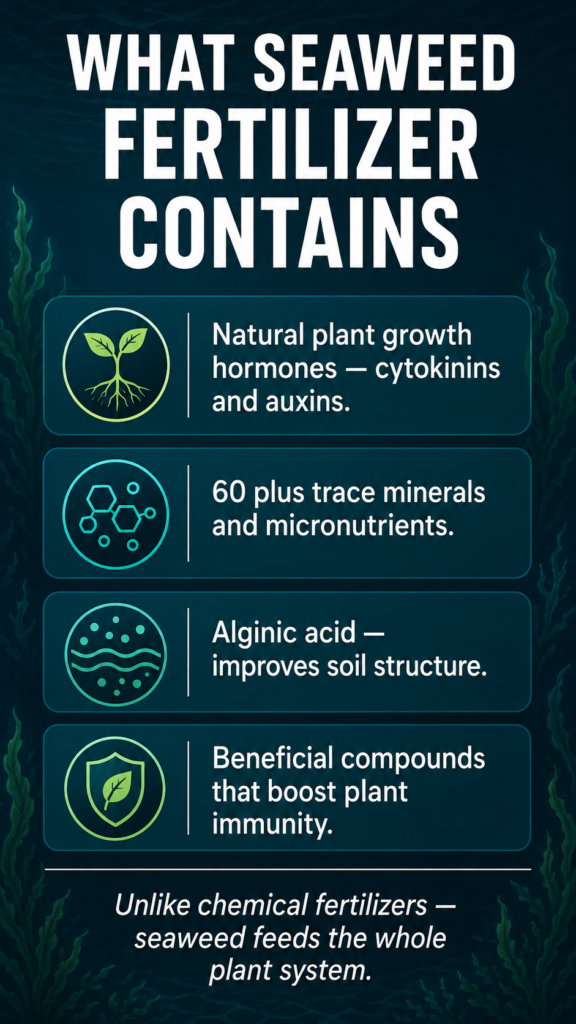
Most fertilizers work by supplying macronutrients — nitrogen, phosphorus, potassium — directly to the plant. Seaweed fertilizer does that too, but its real value lies elsewhere. It is exceptionally rich in natural plant growth hormones, particularly cytokinins which stimulate cell division and auxins which drive root development. It contains over 60 trace minerals and micronutrients that most synthetic fertilizers don’t include — iron, manganese, zinc, boron, copper, molybdenum. And it contains alginic acid, a natural compound that improves soil structure, enhances moisture retention, and feeds beneficial soil microorganisms.
In simple terms — seaweed fertilizer doesn’t just feed your plant. It builds the entire growing environment that makes your plant healthier from the roots up.
The result is plants that grow stronger rather than just faster. Thicker stems, deeper root systems, more vibrant leaf color, and noticeably better resilience against temperature stress, drought, and pest pressure.
Can You Use Seaweed Fertilizer on Indoor Plants
Yes — and seaweed fertilizer is arguably better suited to indoor plants than outdoor ones. Here is why.
Outdoor plants grow in large volumes of soil with active microbial ecosystems that buffer nutrient imbalances. They have room for error. Indoor plants live in a closed pot environment with limited soil volume, no natural replenishment cycle, and far more sensitivity to salt buildup from chemical fertilizers.
Seaweed fertilizer addresses all of this. It carries an extremely low salt index — meaning it does not contribute to the mineral salt accumulation that damages roots over time with synthetic fertilizers. It is pH neutral. It feeds gently and consistently rather than in aggressive doses. And it actively improves the soil biology inside that closed pot, creating a healthier root environment with every application.
For indoor plant owners specifically, seaweed fertilizer solves a problem that most people don’t even know they have — the slow, gradual degradation of soil health inside a pot that never gets replenished the way outdoor soil does.
How to Use Seaweed Liquid Fertilizer for Plants
This is the part most people want — the exact method, not just the theory. Here is how to use seaweed fertilizer on your indoor plants correctly.
Step 1 — Choose liquid over powder for indoor plants
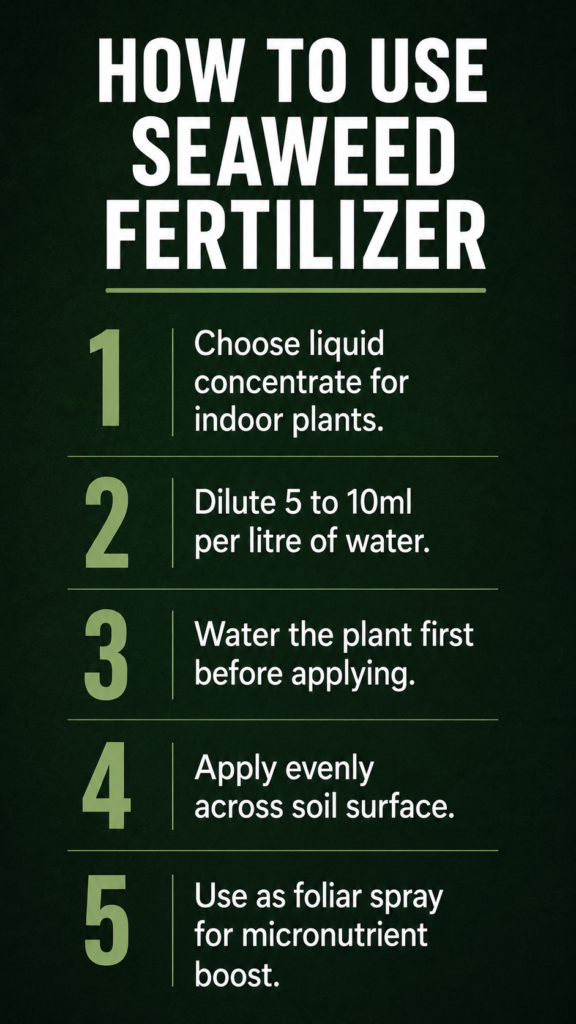
Seaweed fertilizer comes in liquid concentrate and powder form. For indoor houseplants, liquid is the better choice. It distributes evenly through the soil with each watering, reaches the roots immediately, and is far easier to dilute accurately. Powder forms work well in outdoor garden beds but are harder to apply consistently in pots.
Step 2 — Dilute correctly
This is the most important step. Seaweed liquid fertilizer is a concentrate and must be diluted before use. The standard dilution for most products is five to ten millilitres per litre of water for soil application. Check your specific product instructions — our Seaweed Liquid Fertilizer includes clear dilution guidance on the label.
Do not use it undiluted. Even though seaweed fertilizer has a very low burn risk compared to chemical fertilizers, concentrated application directly to roots is unnecessary and wasteful.
Step 3 — Water the plant first
Before applying any fertilizer, water the plant normally and allow it to drain. Applying fertilizer to moist soil protects the roots and helps distribute the diluted seaweed evenly through the root zone.
Step 4 — Apply evenly across the soil surface
Pour the diluted seaweed fertilizer slowly and evenly across the entire soil surface. Allow it to drain through the pot normally. Every part of the root system should receive equal nutrition — avoid concentrating it in one spot.
Step 5 — Use as a foliar spray for micronutrient boost
Seaweed fertilizer can also be applied directly to leaves as a foliar spray. Dilute to a lower concentration — roughly two to three millilitres per litre — and spray both the top and underside of leaves in the early morning or evening, never in direct midday sun. Foliar application delivers micronutrients directly through the leaf surface and is particularly effective for plants showing signs of interveinal chlorosis or micronutrient deficiency.
If you have been wondering why your plant leaves are turning yellow despite correct soil care — foliar seaweed spray is often the fastest fix for micronutrient-related yellowing. Read our full guide on why plant leaves turn yellow for a complete diagnosis.
When Should I Use Seaweed Fertilizer
Timing your seaweed fertilizer applications correctly makes a significant difference to how well your plants respond. Here is a clear breakdown.
During active growth — spring and summer
This is the primary feeding window for all fertilizers including seaweed. In India, active growth runs from roughly February through October given the warmer climate — longer than the standard March to August advice written for colder regions.
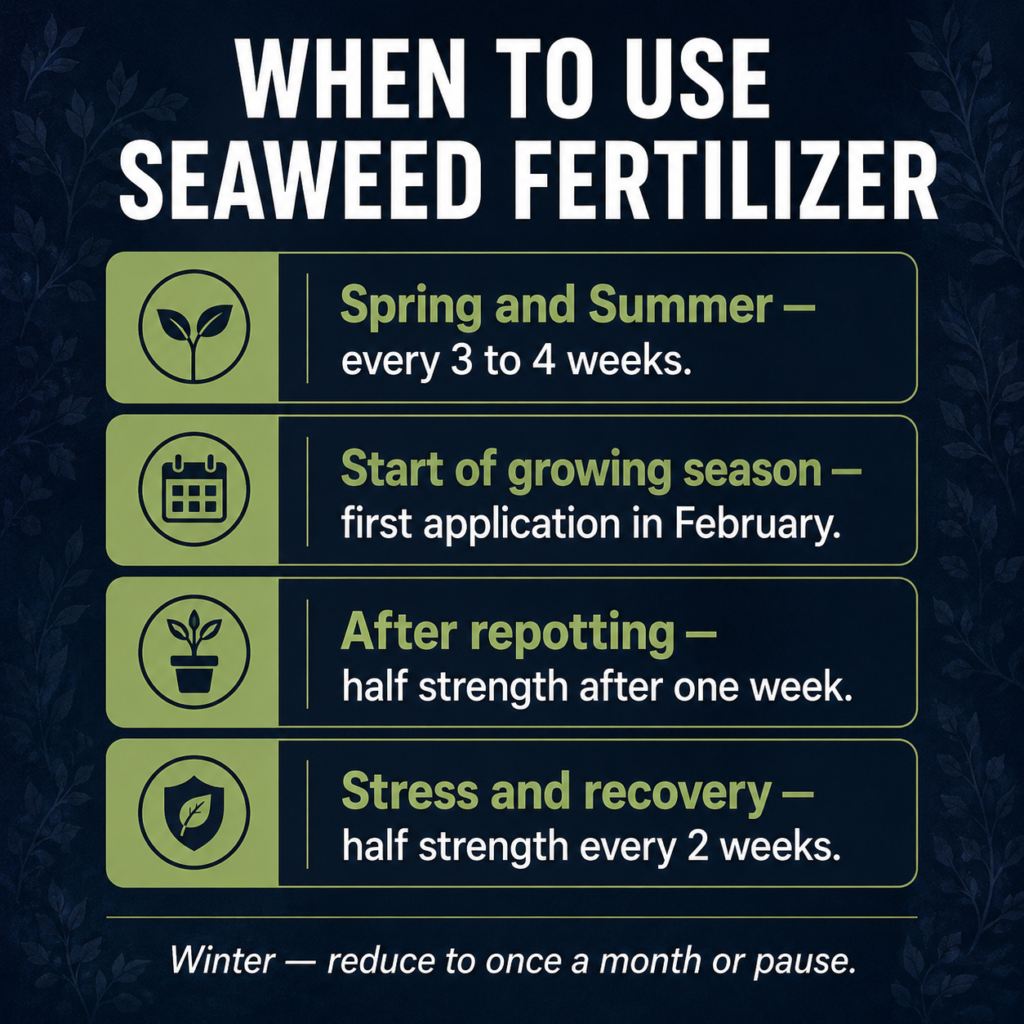
Apply seaweed fertilizer every three to four weeks during this period. Its gentle, consistent nutrient delivery works best as a regular maintenance routine rather than an occasional heavy dose.
At the start of the growing season
The first application in late February or early March — just as the plant is waking up from its winter slow period — is one of the most impactful single applications you can make. The cytokinins in seaweed extract actively stimulate new growth initiation, helping the plant break dormancy faster and start producing new leaves earlier in the season.
After repotting
Seaweed fertilizer is one of the few fertilizers that is safe to use shortly after repotting. Because it feeds gently and contains root-stimulating auxins rather than high-concentration macronutrients, a diluted application one week after repotting actually helps the disturbed root system re-establish faster. This is different from chemical fertilizers which should be withheld for four to six weeks after repotting.
If you have just repotted a plant and want to support recovery, a half-strength seaweed application one week after repotting is an excellent practice. Read our full guide on how to repot a plant without killing it for the complete repotting process.
During stress and recovery
When a plant has been through temperature stress, pest damage, or is recovering from overwatering, seaweed fertilizer’s natural compounds — particularly the cytokinins and natural plant immunity boosters — help the plant recover faster than it would on its own. Apply at half strength every two weeks during the recovery period.
Reduce or stop in winter
Like all fertilizers, reduce seaweed applications in November through January when most indoor plants slow down. You can apply at half strength once a month during this period if the plant is still showing some active growth — seaweed’s gentleness makes it one of the safer fertilizers to use sparingly in low-growth periods. But do not maintain a full summer schedule through winter.
Is Seaweed Fertilizer Good for All Plants
Yes — with very few exceptions. This is one of seaweed fertilizer’s most practical advantages. Its gentle, broad-spectrum nutrient profile and low salt index make it suitable across almost every plant type you are likely to grow indoors.
Tropical foliage plants — pothos, monstera, philodendron, ferns
These respond exceptionally well to seaweed fertilizer. The combination of nitrogen support for leaf production and natural growth hormones produces noticeably lusher, larger leaves and faster growth rates during the growing season.
Flowering houseplants — peace lily, anthurium, African violet
Seaweed fertilizer’s cytokinin content supports flower initiation and extends bloom cycles. Apply as a foliar spray every two weeks during the budding period for best results alongside a balanced soil feed.
Succulents and cacti
Yes, succulents benefit from seaweed fertilizer — but with important modifications. Use at quarter strength rather than the standard dilution. Apply once every six to eight weeks during summer only. The trace minerals and soil-conditioning compounds benefit succulents without the risk of the overly lush, soft growth that higher-nitrogen fertilizers produce in drought-adapted plants.
Orchids
Seaweed fertilizer is one of the most recommended natural options for orchids precisely because it is gentle and free of the harsh salts that accumulate in orchid bark media. Apply at quarter to half strength once a month during active growth.
Newly propagated plants and seedlings
Young plants with underdeveloped root systems are where seaweed fertilizer truly shines. Its root-stimulating auxins directly support root development at the exact stage when it matters most. Apply at half strength from the first week after a cutting is moved to soil — something that would be genuinely risky with a chemical fertilizer.
The only plants to be cautious with
Nitrogen-fixing plants like legumes don’t need additional nitrogen supplementation and may not benefit as significantly from seaweed fertilizer’s growth stimulation. But for the vast majority of houseplants most Indian home gardeners grow — the answer is an uncomplicated yes.
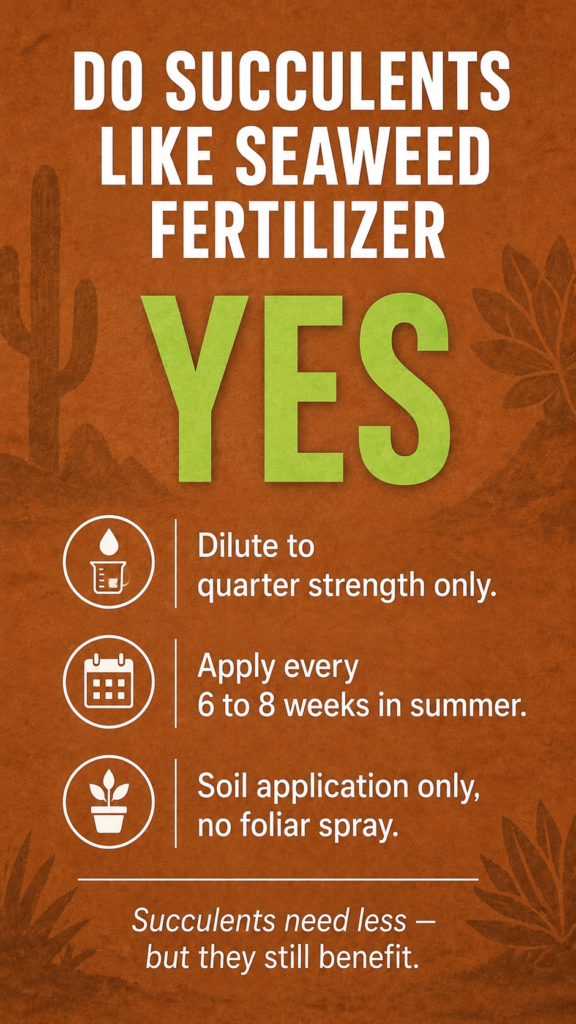
Do Succulents Like Seaweed Fertilizer
Yes — but succulents need seaweed fertilizer applied differently from most other houseplants.
Succulents evolved in nutrient-poor, arid environments. Their roots are adapted to absorb very efficiently from lean soil. This means they are far more sensitive to overfeeding than tropical plants, and the wrong fertilizer at the wrong dose produces the exact opposite of what you want — soft, etiolated, weak growth that is more susceptible to rot.
Seaweed fertilizer is actually one of the best fertilizer options for succulents precisely because of its gentleness. Here is how to use it correctly on succulents:
Dilute to quarter strength — two to three millilitres per litre rather than the standard five to ten.
Apply once every six to eight weeks during summer only — never in winter when succulents are fully dormant.
Soil application only — avoid foliar spraying on succulents, as water sitting on fleshy leaves can encourage rot.
The trace minerals and soil conditioning compounds in seaweed benefit succulents subtly but meaningfully — improved root health, better stress resistance, and more vibrant coloration are the typical results over a full growing season.
Is Seaweed Fertilizer Enough for Plants
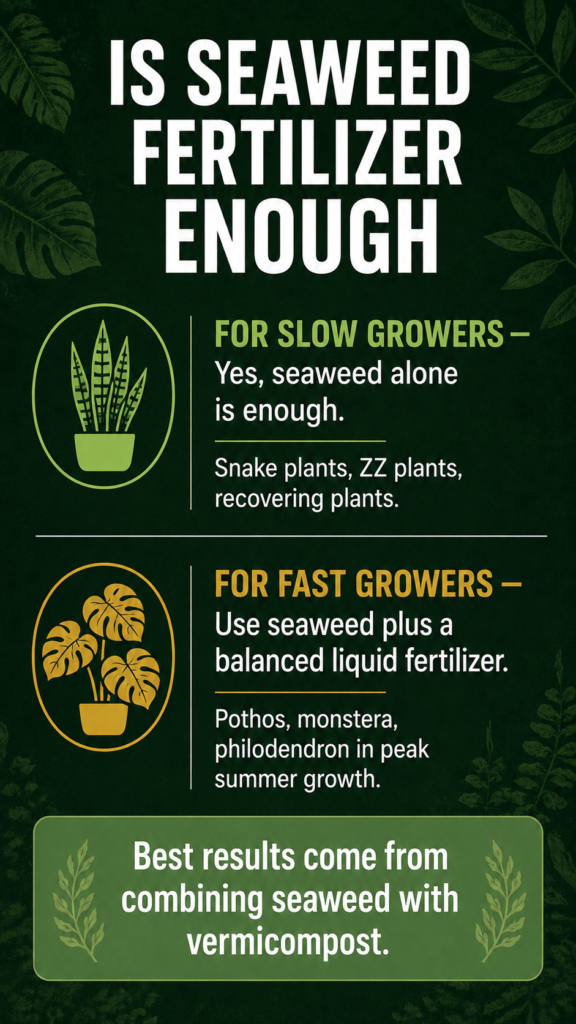
This is the honest answer: seaweed fertilizer alone is enough for light maintenance feeding, but for plants in active heavy growth, it works best as part of a complete nutrition strategy.
Here is why. Seaweed fertilizer is not primarily a macronutrient source. Its NPK ratio is low — typically around 1-0-1 or similar depending on the product. This means it does not deliver the concentrated nitrogen hit that a fast-growing monstera or pothos needs during peak summer growth.
What seaweed fertilizer does exceptionally well is supply micronutrients, plant hormones, soil biology support, and stress resistance compounds — things that standard NPK fertilizers don’t provide at all.
The most effective approach for indoor plants is this combination:
Seaweed liquid fertilizer every three to four weeks as your base feed throughout the growing season. This handles micronutrients, soil health, and hormone support.
A balanced liquid fertilizer at half strength once a month alongside it during peak growth months — April through July in India. This covers the macronutrient demand of actively growing foliage plants.
Vermicompost top dressing once every four to six weeks as a slow-release background nutrient source.
Together these three cover the complete nutritional spectrum — and none of them carry meaningful burn risk when used at the doses described.
If you want to understand the full fertilizing picture — when to use what, in what doses, and why — read our complete guide on how to fertilize indoor plants.
For plants that are not in heavy active growth — slow growers like snake plants and ZZ plants, or any plant in a recovery phase — seaweed fertilizer alone is genuinely sufficient. It keeps the soil biology healthy and the plant nourished without the risk of overfeeding.
Seaweed Fertilizer vs Chemical Fertilizer — Which Is Better for Indoor Plants
This comparison comes up constantly and deserves a straight answer.
Chemical fertilizers deliver high concentrations of NPK quickly. You will see fast results — sometimes within days. But that speed comes with tradeoffs that matter particularly in the closed environment of a pot.
Chemical fertilizers contribute to mineral salt buildup in the soil over time. In a garden bed, rainfall and large soil volumes dilute and flush these salts naturally. In a pot, they accumulate. Over months this damages root cells, restricts water absorption, and produces the brown crispy leaf tips that many plant owners attribute to other causes. Read our guide on how to fertilize indoor plants for a full explanation of fertilizer salt toxicity and how to fix it.
Seaweed fertilizer has an extremely low salt index. It does not contribute to buildup. It improves soil biology rather than degrading it over time. And it delivers a spectrum of nutrients and biological compounds that no synthetic fertilizer replicates.
The honest comparison is this. Chemical fertilizers are faster but carry real risk in a pot environment with consistent use. Seaweed fertilizer is slower but builds cumulative health over a full growing season without the risk. For indoor plants specifically — where soil health compounds over months in a closed environment — seaweed fertilizer is the more intelligent long-term choice.
Quick Reference — Seaweed Fertilizer Cheat Sheet
What it is — liquid concentrate from marine algae, rich in hormones, trace minerals, and soil conditioners
Best for — all indoor plants including sensitive varieties, seedlings, and recovering plants
Standard dilution — 5 to 10ml per litre for soil application, 2 to 3ml per litre for foliar spray
How often — every 3 to 4 weeks during growing season, once a month or pause in winter
For succulents — quarter strength, every 6 to 8 weeks in summer only
After repotting — half strength one week after repotting, safe to use earlier than chemical fertilizers
Is it enough alone — yes for slow growers, combine with balanced liquid fertilizer for fast growers in peak growth
Salt buildup risk — extremely low, safer than chemical fertilizers for long-term pot use
Can it burn roots — very unlikely at correct dilution, far safer than synthetic NPK fertilizers
Frequently Asked Questions
Can you use seaweed fertilizer on indoor plants every week?
Weekly application is more than most indoor plants need. Even though seaweed fertilizer is gentle and low-risk, applying it every week provides no additional benefit over every three to four weeks and may lead to minor buildup of organic compounds over time. Every three to four weeks is the optimal frequency for soil application. If you want to increase frequency, dilute to half the standard concentration and apply every two weeks — this keeps delivery consistent without excess accumulation.
When should I use seaweed fertilizer on my plants?
The primary window is spring through summer — February to October in India. The single most impactful application is the first one at the start of the growing season in late February or early March, when the plant is coming out of its winter slow period. The natural cytokinins in seaweed actively help the plant break dormancy and initiate new growth faster. After repotting is also an excellent time — seaweed’s root-stimulating compounds support re-establishment in a way chemical fertilizers cannot.
Is seaweed fertilizer good for all indoor plants?
Yes for the vast majority. Tropical foliage plants, flowering houseplants, succulents at quarter strength, orchids, and newly propagated cuttings all respond well to seaweed fertilizer. The key adjustment is dose — standard strength for most plants, quarter strength for succulents and cacti, half strength for seedlings and recovering plants.
Can I use seaweed fertilizer and chemical fertilizer together?
Yes but space them out. Apply seaweed fertilizer and a balanced chemical fertilizer on alternating weeks rather than together. Combining them in the same watering session is unnecessary and adds more nutrient load than most indoor plants need at once. Using them on alternating weeks gives you the fast macronutrient delivery of chemical fertilizer alongside the micronutrient and biological benefits of seaweed.
Does seaweed fertilizer smell bad?
Fresh seaweed liquid fertilizer has a distinct earthy, ocean-like smell that some people find strong. It dissipates within a few hours of application as it is absorbed into the soil. If the smell is a concern, apply it in a well-ventilated space and the odor will be gone by the time the soil dries. High-quality cold-processed seaweed fertilizers typically have a milder, more neutral smell than cheaper heat-processed alternatives.
How long does it take to see results from seaweed fertilizer?
Seaweed fertilizer works more gradually than chemical fertilizers. Visible results — new leaf emergence, deeper color, perkier growth — typically appear within three to four weeks of starting a regular application routine. Root health and stress resistance improvements happen faster but are not visible above the soil. If you are expecting the overnight transformation of a high-nitrogen chemical fertilizer, seaweed will feel slow. If you are building long-term plant health, four weeks of consistent use will show you a meaningfully different plant.
Is seaweed fertilizer the same as seaweed extract?
They are closely related but not identical. Seaweed extract is the concentrated active compound derived from seaweed — the hormones, minerals, and biological compounds — without significant macronutrient content. Seaweed fertilizer typically contains the extract plus some level of macronutrients and is formulated specifically for plant feeding. In practice, most liquid seaweed products sold for gardening are essentially seaweed extract in fertilizer form, and the terms are used interchangeably by most manufacturers.
The Bottom Line
Seaweed fertilizer is not a trend. It is one of the oldest plant feeding methods in existence, and the science behind why it works is well established. For indoor plants specifically — where soil health, salt sensitivity, and root environment matter enormously — it is one of the most sensible fertilizer choices available.
Use it consistently throughout the growing season. Combine it with vermicompost for complete nutrition. And give it four weeks before you judge it — because what it builds is not a quick flush of growth but a genuinely healthier plant from the roots up.